Back in the olden days – I’m talking about the 1980’s/90’s – I bought plenty of teen magazines and on the back page you could usually find lists of people looking for pen pals or organizations that facilitated matching pen pals. I instantly loved the idea! The first person I wrote to was named Jennifer Dumas and she was somewhere in New York. I think we convinced ourselves in our pre-internet world that we were related, but we didn’t keep up with our letters. (Hi Jennifer, if you ever see this!) At the end of 1990 I found a form for setting people up with foreign pen pals. I selected Russia from the list of countries and was connected to a 15-year-old boy in Tomsk, Siberia named Maxim. According to his letter, I was his first American friend.
Maxim and I exchanged only a few letters back and forth starting in April of 1991 and ending in December of that year. I received a letter dated October 23, 1991, from him and I sent a package with a Christmas gift a little while after, not knowing how the world around us would soon change. December 26, 1991, marked the end of the Soviet Union. We saw Gorbachev resign and Yeltsin take over as president of the country no longer called the USSR. As a naive teen, I thought the political changes would somehow make it easier to correspond with Maxim, but the opposite was true; I never heard from him again. The October letter was the last I received.
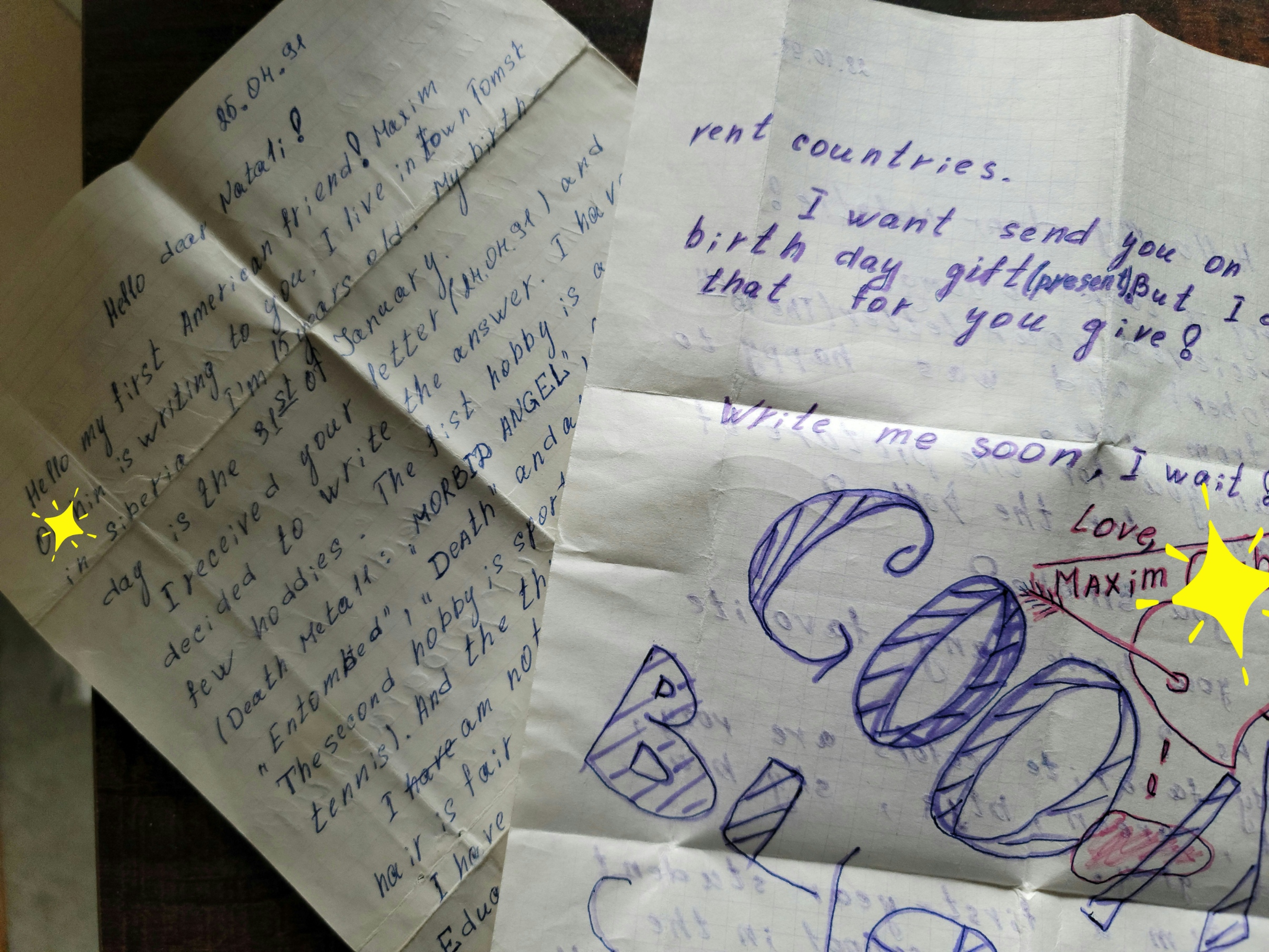
I don’t know why he stopped writing. I wrote one more letter after the Christmas package, but didn’t keep it going. I’ve kept the letters, one of the envelopes with his old address, a plastic fly he added to one of the letters as a gag, and a picture of Elton John from a Russian magazine. Sir Elton was on the list of music I listened to, which was very different from his list of “death metal” bands. I had family who were convinced he wasn’t real, that the pen pal I’d signed up for was a scam, a government agent trying to fool me, or someone trying to find a way into this country. Maybe they were right. But I have a black and white photo of a solemn kid with dark hair and a striped shirt, and that kid at least was real somewhere.
Probably because of growing up in the 80’s in the shadow of the Cold War, Russia was almost a curiosity. The balance of life and culture in an atmosphere that was so …well, foreign, lacking freedoms that we took for granted, struck me. An uncle visited Moscow in the mid 80s and brought back stories of what life was like that were in line with what we’d been told on the news. He also brought me a classic matryoshka set that still sits on my bookshelf, now with a second bought for me by my husband, who by chance, is of Russian descent. Those dolls, the artistry, the global recognition, have always signified the other part of Russia to me. The part of Russia made up of people like me, not politics. People like Maxim and his family that included an older brother and a niece, not brutal leaders.
When I signed the publication deal for The Myth Maker, I ended up facing a question I hadn’t expected – was I alright with it being published in Russian? It wasn’t a question I’d given any thought to before I opened the email with the request, and while I completely understand why a writer would decide not to, I said yes. The question made me search for the letters and helped me with my answer. See, there’s a character in my novel very loosely based on Maxim. His dark hair and grey eyes inspired the character of Nicky Danishevsky, who is also of Russian descent, and if I get to write more Cassidy Cantwell novels, readers will actually get to know more about him. How could I exclude Russian people then?
My decision was completely removed from politics – past or present. It was about the readers, not the leaders. As I start out in this publishing game, I don’t want to leave anyone out. Also, here in Washington state, the Russian language is in the top five of languages spoken here, out of over 160 languages. Languages move, people move, regimes stay in place, but I wanted to make sure if someone like Maxim wanted to read The Myth Maker in their mother tongue, they’d be able to do so.